Are Job Boards Outdated?

- Apr 02
- Communications jobs, Finding jobs, Hoojobs, Job Advice, Public Relations jobs, Social Media Jobs
- No Comments
We can all agree on something: generalist job boards are not seeing their best times. Famous large-scale job boards have shown a decline in revenue per posting as they face competition from those that focus on niche markets (targeting jobs by location or industry type), and also from social network platform outreach. So the question is: how important are niche job boards for recruitment nowadays?
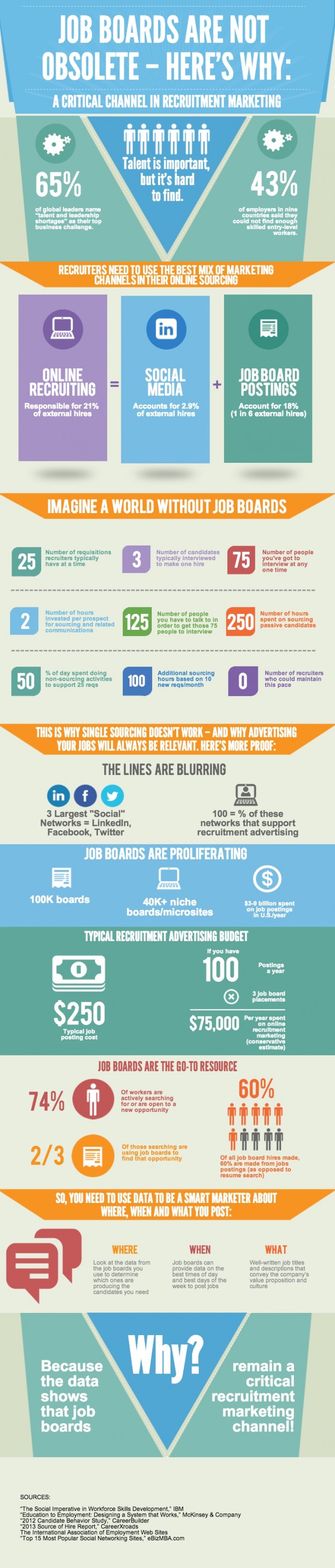
From a recruiter’s perspective, the less time you spend weeding out unrelated candidates, the better chances you have of finding the perfect match. From a job seeker’s perspective, the more relevant the job board, the better odds of getting noticed. When done right, it’s a win-win situation and the key to the success is to find the right job board for your position. According to eQuest, job board postings account for 18% of hires, i.e. 1 in 6 external hires, while social media embraces 2.9%. That results in a total of 21% of external hires happening via online recruitment, a percentage that has been increasing more and more over the past decade.
Job postings vs. resume search
Here’s the scenario without job postings: a recruiter receives an average of 25 requisitions at a time and spends 50% of his time doing non-sourcing activities to support them. They typically interview 3 candidates to make one hire, which means they end up having to interview 75 people. But in order to make it happen, they also reach out to every single one of these candidates individually, and that takes time – an average of 2 hours spent on sourcing and related communications with those prospects. In order to talk to those 75 prospects, the recruiters talk to an average of 125 other people along the way and spend a total of 250 hours sourcing passive candidates. Ugh, ‘ain’t nobody got time fo dat’ – and that’s when niche job boards come to save the day.
When companies choose the right job board to post an open position and write a good job description, chances are they’re getting faster and more relevant responses from active job seekers. From the working population, 73% are actively searching and open to embrace a new opportunity, and 2/3 of them are using job boards. And to show a clear winner, 60% of all hires made on job boards come from job postings as opposed to resume search.
Tips to find the right job board
Whether you’re seeking or offering a job, you need to find the right place to do it. The more demanding the requirements, the harder it is to find the offer that matches your needs. Entry-level jobs are easier to target, you can either focus by location (“public relations job in New York”) or by industry type (“social media coordinator positions”). A senior level position such as a VP of Communications for example, will demand much more digging and patience to find the right fit.
The following rule serves both recruiters and job seekers: the positions that stand out on a job board are the ones that clearly portray the company’s culture, values and expectations. Details are important and the wording makes a difference. When you send a cover letter along with your resume, use it to your advantage. Take this space to convince the recruiter why your previous skills are a great addition to the company.
And remember, recruiters: posting your position on the right board at the right time does more than attract the best talent – it keeps your company’s brand relevant in the market.